

Five days. That’s how long it took.
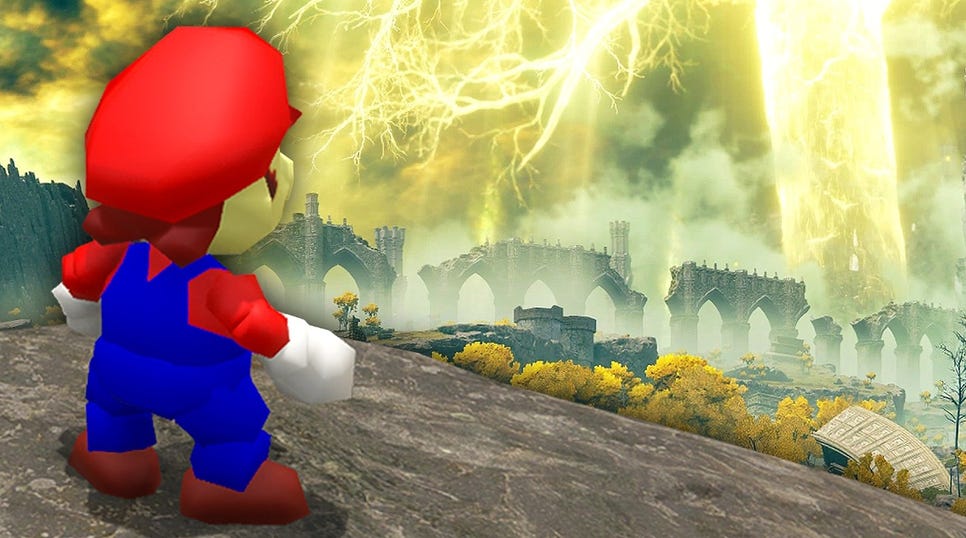
Five days after a project hit GitHub, that essentially let people create “Passthrough Mods”, the internet was already watching Spider-Man swing through Arkham City, Mario hop through the Lands Between, and a dwarf ride a skateboard through World of Warcraft doing Tony Hawk flips. Not mods in the traditional sense, not a texture swap or a model replacement slapped on top of an existing engine. These were reverse-engineered, entire games taken apart, their code understood and rewritten, then stitched together with something else entirely. (RUST usually. The language, not the survival game that starts with your ween out.)
Anyway, the thing that struck me wasn’t the mashups themselves. It was how quickly I stopped being impressed by them.
The Mashup Isn’t the Point
Let me be clear: Mario 64 in Elden Ring is cool. It’s also kind of stupid. You run around as Mario, the game probably breaks within five minutes, and the novelty wears off before the video ends. The Mirror’s Edge / Skyrim mashup is fun for exactly as long as it takes you to do one parkour flip off a building in Winterhold. Spider-Man in Arkham City is a neat clip and not much of a playable experience.

The mashups are content farm fuel. They exist to make a viral video, to get a click, to generate a headline. That’s fine. That’s how the internet works these days, for good or ill. But if all this technology produces is a hundred more “look at this weird thing” clips, it’ll be a footnote.
The interesting question isn’t what you can mash up. It’s what happens to the idea of a game when mashing becomes trivial.
What Passthrough Modding Actually Does
To understand why this is different from traditional modding, you have to understand what was released. Passthrough modding doesn’t just inject assets into a game. It reverse-engineers entire pieces of software, aka reads the code, understands its structure, and reproduces it in a new form. You’re not bolting Mario onto Elden Ring’s engine. You’re reconstructing Elden Ring’s logic and running Mario inside it.
That’s a fundamentally different capability than anything the modding community has had before. Traditional modding is like adding a room to a house. This is like 3D-printing a replica of the house and then deciding the replica should have a skateboard ramp in the living room. And maybe a headless horse in the bathroom. Sky’s the limit.
And it’s not just games. Passthrough modding works on any software. Which means the implications go far beyond “what if Master Chief was in Stardew Valley.” It means the entire concept of a fixed piece of software is starting to erode. Everything becomes malleable. Everything becomes a starting point.
The Monopoly Problem

Here’s the thing that makes this more than a tech curiosity: players have always done this.
Since it came up on the last CORE, let’s talk about the Monopoly board game example. Monopoly has been the same game for a hundred years, and almost nobody plays it by the actual rules. Everybody has house rules. “Free parking” gives you money for some but not everyone. You can’t buy properties on the first lap. Nobody reads the manual. Everybody argues about it. The game as designed and the game as played are two different things.
That impulse, to take a game you love and bend it into the shape you want, is kinda universal. Iron Man challenges in MMO’s. Speedrun categories. Randomizers. Pacifist runs. Players have been modding games with rules for as long as games have existed.
The difference now is that AI doesn’t just let you mod the rules. It lets you mod the code. Instantly. Without a modding community. Without a developer kit. Without permission.
The Studio Problem
Here’s where it gets uncomfortable for the people who make games.
Blizzard, Capcom, and every other major studio are already using AI internally. Capcom recently talked about using AI to streamline development in their RE Engine, not to generate assets, but to, “speed up internal processes and get past technical hurdles”, as Jon put it in our last episode. Every studio is doing some version of this. It’s not popular to admit it, but it’s happening.
So what happens when the same tools are in players’ hands?
The Dota story is the cautionary tale. Defense of the Ancients was a mod. A community project built on top of Blizzard’s engine. Blizzard could have embraced it, brought it in-house, made it the future of their RTS business. Instead, they let it drift, eventually to Valve, where it became Dota 2. Riot took the same formula and made League of Legends, and so on.
Blizzard missed the MOBA boom because they didn’t understand what their own modding community was building. And Heroes came just a little too late.
The “Cheapening” Question
There’s a real fear buried in all this, and it’s worth taking seriously: does tearing games apart and reassembling them cheapen the medium of games entirely?
On one hand, yes. A game is a work of art. It has intent. It has design. It has a creator’s vision. Mashing Mario into Elden Ring is, in some sense, a violation of that vision. It treats the game as raw material rather than a finished statement.
On the other hand, that’s what players have always done. We’ve been breaking games since we first got our hands on them. We’ve been finding exploits, bending rules, creating challenges, and rewriting the experience to suit ourselves. The medium has always been participatory. AI just makes the participation faster and more powerful. (Counter-arguments can of course be made.)
And honestly, the studios that understand this are the ones that will likely thrive. The ones that fight it, that try to lock down their games, prevent modification, and preserve the “intended experience” AT ALL COISTS, are going to find themselves in a tricky place potentially. The genie isn’t going back in the bottle.
So What Now?
We’re in the “microwavable burrito” phase of AI game creation. Somebody just figured out you can make one in two minutes instead of twenty, and everyone’s making videos about how fast it is. That’s not the interesting part.
The interesting part is what happens when someone uses these tools to make something that’s actually good. A fully realized mashup with a beginning, a middle, and an end. A new way to play a game you’ve played a thousand times. I’m not sure this will even happen for sure, but in theory, that’s the track we are on.
The conversation about what a “game” even is seems to be changing. Maybe a little too quickly. Love to hear your thoughts. (Scott)